Quick answer: A microwave wins for speed and everyday convenience — reheating, defrosting, and quick cooking. An OTG (Oven, Toaster, Griller) wins for baking, grilling, and roasting, because it heats with dry radiant heat rather than electromagnetic waves, giving cakes, cookies, and tandoori-style dishes a proper crust and rise. If you had to own just one and you bake often, choose an OTG or a convection microwave. If you mostly reheat and rarely bake, a solo or grill microwave is the better fit.
Despite all the hammerings of information related to technology-driven devices for cooking, many are often left confused when it comes to buying a Microwave or OTG. In this article, we try to highlight the differences between the microwave and oven (Microwave Vs OTG), which may help you to decide what suits your requirement.
Let’s dive in further to understand in detail.
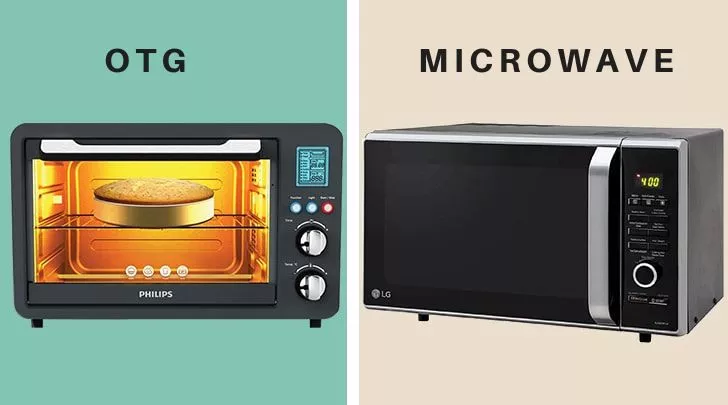
Microwave
If you are looking to cook or reheat your food instantly, then the microwave oven will be your blue-eyed boy. It allows you to reheat leftovers instantly before you want to dispose of them.
You can instantly cook cakes, pizzas, omelettes, and even idlis and dhoklas and feast on them.
OTG
When it comes to baking, it’s all about OTG. You can bake, toast, broil and grill your food. You can make kebabs and grill food with its unique rotisserie function. If you are looking to bake a perfect cake, then OTG is the only option.
With an OTG, you can bake cakes, bread, cookies, pizza, muffins, tarts, chicken, fish, vegetables, kebabs, etc.
Microwave v/s OTG – Cooking Time Comparison
Today’s microwave has many enhanced features than an OTG and therefore it offers more versatility. It cooks food fast as compared to the OTG. Modern microwaves also have grilling and low-oil frying or air-frying options. With the auto-cook options in some microwaves, you can pre-set the time and temperature settings for cooking depending on the food.
An OTG doesn’t have all the above features. It will bake, toast, broil and grill your food. In the real sense, OTG doesn’t cook anything. So, if you are looking for some cooking aid to save your time, OTG won’t suffice.
The time taken to bake on both devices is the same.
Microwave vs OTG – Capacity
A convection microwave has a max capacity of 32 litres while the OTG can reach up to 60 litres. In addition, the rotating surface in a microwave is small, which limits us to put large plates into it. On the other hand, an OTG has a larger space and is easy to handle due to its lightweight.
So, to bake large quantities of food, an OTG can be an ideal option, beating the microwave in this area.
You may like: OTG under Rs. 5000
Microwave vs OTG – Mechanism
A microwave heats the molecules in the food to cook it. Food is evenly cooked due to the rotating plate and microwaves.
In OTG, a heated coil passes the heat to the food and a fan present in the device distributes the heat to different parts.
Microwave vs OTG – Preheat time
A microwave takes only 5 minutes to preheat, while the OTG takes about 15-20 minutes.
Microwave vs OTG – Price
A microwave may come for around Rs. 16,000/-, while an OTG may come for around Rs. 10,000/- approximately.
OTG vs Microwave Comparison Table
| Factor | OTG | Microwave |
|---|---|---|
| Heating method | Electric coils (radiant heat) | Electromagnetic waves |
| Cooking speed | Slower | Faster |
| Baking performance | Excellent | Poor unless convection mode |
| Grilling performance | Excellent (with rotisserie) | Good only with grill/convection mode |
| Reheating | Slow, can dry out food | Fast, efficient |
| Defrosting | Not supported | Dedicated defrost setting |
| Energy consumption | Lower wattage, longer runtime | Higher wattage, shorter runtime |
| Food texture | Crisp, browned, well-risen | Soft, sometimes rubbery without convection |
| Ease of use | Manual controls, more attention needed | Digital presets, easier daily use |
| Price range | Generally lower for comparable capacity | Higher, especially convection models |
| Maintenance | Simple but needs grease cleanup | More electronics, easier surface cleaning |
How can you use Microwave to bake?
If your microwave has a mode called “Convection” mode, you can bake in the same way as an OTG. These ovens are called convection ovens. If the microwave doesn’t have this kind of utility, they are called solo ovens.
Solo ovens are cheaper than convection ovens, so you can go for a solo oven if you don’t require baking functions frequently.
Which Is Better for Baking?
OTG, hands down — unless your microwave specifically has a convection mode. Baking depends on dry, even heat surrounding the food long enough for the structure to set and the surface to brown (the Maillard reaction). A solo or grill microwave heats moisture inside the food rapidly but does nothing for the surface, which is why microwave-baked batters often come out pale, dense, and slightly rubbery instead of risen and golden.
Which Is Better for Pizza?
OTG again, for the same reason: a crisp base needs sustained bottom heat plus top browning for the cheese. A convection microwave can produce a passable homemade pizza, but a dedicated OTG with a preheated tray typically gives a closer result to a tandoor or conventional-oven pizza.
Which Is Better for Cakes?
OTG or a convection microwave — never a solo or grill-only microwave. The fan-assisted, even heat in both is what allows a cake to rise properly and develop a stable crumb. Between the two, most home bakers find OTGs slightly more forgiving and consistent for cakes, since the larger chamber and stronger coils tolerate minor technique mistakes better than a compact convection microwave does.
Which Is Better for Grilling?
OTG, particularly if it includes a rotisserie. The combination of strong top-element heat and (in rotisserie models) constant rotation gives more even charring on kebabs, tikkas, and vegetables than a microwave’s grill mode, which is constrained by a smaller cavity and shorter recommended run times.
Which Is Better for Reheating Food?
Microwave, without much debate. It’s faster, doesn’t dry out rice, curries, or rotis the way prolonged OTG reheating can, and uses less total energy for short reheating tasks. This is the single area where microwaves are unambiguously superior.
Which Is Healthier: OTG or Microwave?
This is the most-searched question in this entire cluster, and most articles answer it with opinion rather than evidence. Here’s what the actual research shows.
Nutrient Retention
Multiple food-science reviews have found that microwave cooking does not uniquely destroy nutrients — and in several comparisons, it preserves vitamins better than boiling or extended oven cooking, simply because cooking times are shorter and less water is used in the process. Cooking by any method causes some breakdown of nutrients, but plenty remain after cooking, and shorter cooking times mean fewer nutrients break down. OTG baking and roasting, because it runs longer at sustained heat, can in some cases cause slightly more nutrient degradation in heat-sensitive vitamins (like vitamin C) than a quick microwave reheat — though the difference is generally small and food-dependent.
Oil Usage
Neither appliance inherently requires oil, but in practice, OTG recipes (cakes, roasted vegetables, grilled meats) often call for more oil or butter than microwave reheating does, simply because of the cooking styles each is typically used for — not because of the technology itself. If oil reduction is your health goal, the appliance matters less than the recipe.
Food Texture and Health
There’s no meaningful health difference driven by texture alone. OTG’s browning effect (the Maillard reaction) can, at high enough temperatures over long cook times, produce trace amounts of compounds like acrylamide in starchy foods — the same compound formed during any high-heat browning, including frying and grilling. This is a function of temperature and browning, not of OTG technology specifically, and the same risk exists with conventional ovens, air fryers, or stovetop frying.
Common Myths, Debunked
- “Microwaves make food radioactive.” False. Microwaves use non-ionizing radiation — the same general category as Wi-Fi signals — which heats food but does not alter its atomic structure or make it radioactive.
- “Microwaved food is nutritionally inferior.” Largely false. Current evidence shows microwave cooking does not uniquely destroy nutrients and can often preserve them effectively due to shorter cooking times and reduced water use.
- “OTG-cooked food is always healthier because it’s ‘natural heat.’ Not necessarily — the health impact depends far more on ingredients, oil, and cooking temperature/time than on whether the heat source is radiant coils or electromagnetic waves.
Bottom line: neither appliance is meaningfully “unhealthier” than the other on a scientific basis. What you cook, how much oil/sugar you add, and how long you cook it matter far more than which appliance you used.
OTG vs Microwave Pros and Cons
| Pros | Cons | |
|---|---|---|
| OTG | Excellent baking & grilling, larger capacity for the price, simple mechanical controls, generally lower upfront cost | No reheating/defrost function, slower preheat (15–20 min), needs more hands-on attention, takes more counter space for equivalent capacity |
| Microwave (solo/grill) | Fast reheating & defrosting, compact, easy one-touch use, lower running cost for short tasks | Cannot bake properly without convection mode, smaller usable cavity (rotating tray), grill function is a weak substitute for OTG grilling |
| Convection microwave | All-in-one: reheats, bakes, and grills reasonably well | Higher price than OTG or solo microwave, baking quality usually a step below a dedicated OTG, smaller capacity than most OTGs |
Who Should Buy an OTG?
- You bake cakes, cookies, bread, or pastries regularly (weekly or more)
- You enjoy grilling, roasting, or making tandoori-style dishes at home
- You want the largest cooking capacity for your budget
- You don’t mind manual controls and a longer preheat time
- You already have a separate way to reheat/defrost food (or don’t need to)
Who Should Buy a Microwave?
- Your main use case is reheating leftovers, defrosting frozen food, or quick everyday cooking
- You have limited kitchen counter space and want one compact appliance
- You want digital presets and one-touch convenience over manual control
- You bake only occasionally and would consider a convection model if you do
- You’re a student, bachelor, or small household prioritizing speed over baking capability
Best OTG and Microwave Recommendations
Exact models and prices change frequently with sales and new launches, so treat the ranges below as planning guidance — check current listings before buying.
Best OTGs by Budget and Use Case
- Entry-level (compact, occasional baking): 16–19 litre models from brands like Bajaj, Prestige, or iBELL — sufficient for toasting, small cakes, and single-tray baking.
- Mid-range, most home bakers: 25–35 litre convection-fan models from Borosil, AGARO, Philips, or Inalsa — large enough for a loaf tin, a medium pizza, or a full cake, with a rotisserie option for grilling.
- Large family/serious baker: 40–60 litre models from Morphy Richards, USHA, or Wonderchef — multiple trays, full rotisserie, and digital temperature presets.
Best Microwaves by Budget and Use Case
- Reheating-only, budget/compact: 17–20 litre solo microwaves from Bajaj, Samsung, or LG — fast, simple, no baking ambitions.
- Light grilling + reheating: 20–25 litre grill microwaves from IFB, Samsung, or Godrej — good for toasting and basic browning.
- All-in-one baking + reheating: 27–32 litre convection microwaves from LG, Samsung, IFB, or Panasonic — the closest single-appliance substitute for owning both a microwave and an OTG.
Buy: Best Oven for Baking Cakes
Frequently Asked Questions
What is the difference between OTG and microwave?
An OTG uses electric heating coils to radiate heat onto food from the outside, which is ideal for baking and grilling. A microwave uses electromagnetic waves to heat food from the inside out, which is ideal for fast reheating, defrosting, and basic cooking.
Which is better, OTG or microwave?
Neither is universally better — it depends on use. OTG is better for baking and grilling; a microwave is better for speed, reheating, and defrosting. Many households benefit from owning both, or a convection microwave that combines both functions.
Can a microwave do everything an OTG does?
Only if it has a convection mode. A solo or grill-only microwave cannot bake properly. A convection microwave can bake and grill reasonably well, though usually not quite as well as a dedicated OTG.
Can an OTG be used as a microwave?
No. An OTG has no microwave radiation function, so it cannot replicate fast reheating or defrosting. It only heats via coils, which is much slower for those specific tasks.
Is OTG healthier than microwave?
Not meaningfully. Scientific reviews show microwave cooking does not uniquely destroy nutrients, and in some cases preserves vitamins better than longer cooking methods due to shorter cook times. Health outcomes depend far more on ingredients and oil use than on the appliance itself.
Does microwave cooking destroy nutrients?
No more than other cooking methods — and often less, since microwaving is typically faster and uses less water, both of which help preserve heat- and water-sensitive vitamins.
Which is better for baking a cake, OTG or microwave?
An OTG or a convection microwave — never a solo or grill-only microwave, which cannot produce the rise and browning a baked cake needs.
Can you bake a pizza in a microwave?
Only in a convection microwave. A solo or grill microwave will heat the toppings but won’t crisp the base properly.
What is the difference between microwave, oven, and OTG?
A conventional oven is a large, often built-in appliance using gas or electric heat. An OTG is a smaller, countertop version focused on baking, toasting, and grilling. A microwave uses electromagnetic radiation and is focused on speed, reheating, and defrosting — only convection microwaves can match an OTG’s baking ability.
What is a convection microwave?
A microwave with an added heating element and fan, allowing it to circulate hot air like an oven. This lets it bake and grill in addition to standard microwave functions.
Can a convection microwave replace an OTG?
For most casual baking needs, yes. For frequent or serious baking, a dedicated OTG generally still gives more consistent results and larger capacity for the price.
Which consumes less electricity, OTG or microwave?
It depends on the task. Microwaves use more power per minute but for much shorter durations (ideal for reheating); OTGs use less power per minute but run longer (ideal for baking). Compare running cost by task, not just by wattage.
Which is cheaper, OTG or microwave?
A basic OTG is usually cheaper than a comparable-capacity convection microwave, since it doesn’t include microwave-generating hardware. A solo microwave can be cheaper than an OTG at the entry level, but it also can’t bake.
Can you put metal containers in an OTG?
Yes — OTGs are designed for metal, glass, ceramic, and silicone bakeware. Microwaves cannot safely use metal containers, since metal reflects microwave radiation and can cause sparking.
How long does an OTG take to preheat vs a microwave?
An OTG typically takes 15–20 minutes to preheat to baking temperature. A microwave (including convection mode) is usually ready in about 5 minutes, since it heats up faster electronically.
Which is better for grilling, OTG or microwave?
An OTG, especially with a rotisserie attachment, generally gives more even charring and better texture than a microwave’s grill mode.
Is it safe to use a microwave every day?
Yes. Microwave ovens use non-ionizing radiation, which does not make food radioactive or unsafe. Daily use is considered safe when microwave-safe containers are used as directed.
Should I buy both an OTG and a microwave?
If your budget and kitchen space allow it, yes — this combination covers both fast reheating and proper baking/grilling better than either appliance alone, or a convection microwave trying to do both jobs at once.
Conclusion
It may be hard to find the difference between microwave and OTG. The above information will help you to identify the differences between the two and help you to select one that suits your requirement.
A microwave is much superior to OTG in terms of versatility and saving time. With a convection oven, you can have the functionalities of OTG within a microwave, expanding your cooking range.
On the other hand, if you are baking cakes frequently, the OTG is going to be your first choice. It is cheaper than the microwave and portable due to its lighter weight.